

Registered Training Organisation
Access and Equity
Australian federal and state legislation makes it unlawful for organisations to discriminate against people because of their age, gender, race, marital status, sexuality, physical or intellectual disability.
To ensure access and equity all learners are provided with fair and inclusive opportunities to participate fully in training and assessment.
To support this, trainers, assessors and staff will:
- Consider issues relating to access and equity when specifying course entry requirements
- Offer flexible learning and assessment pathways, including credit transfer and recognition of prior learning, to support diverse learner needs.
- Ensure training and assessment resources are inclusive, culturally appropriate and free from bias or discriminatory content.
- Provide reasonable adjustments to support learners with disabilities or special needs, consistent with legislative and regulatory requirements.
- Ensure language, literacy and numeracy requirements are consistent with the vocational level of the qualification
- Provide alternate formats or delivery modes for learners who may have limited access to digital resources or online learning.
- Consult with learners and support needs to identify and address barriers to participation or completion.
Hamilton Secondary College’s premises provide appropriate access to those with a physical disability.
Reasonable adjustment is provided to those with a disability or additional support needs according to individual circumstances which may include:
- Provision of additional educational support or mentoring.
- Alternative assessment methods or formats.
- Use of assistive technologies or large print materials.
- Extra time to complete a course or assessment tasks.
Students with a disability or additional support needs may be eligible to access specialised support through the National Disability Insurance Scheme (NDIS) or Success and Wellbeing Services (SWS).
Assessment
Assessment is ongoing throughout the course and students will be provided with clear instructions and guidance about assessment requirements, including the type of evidence needed to demonstrate competency. Examples of evidence might include, but is not limited to:
- Practical demonstrations and observations
- Written or oral assessments
- Projects, case studies or reports
- Presentations or portfolios of work.
Before undertaking an assessment, your trainer/assessor will explain:
- The assessment method and tasks
- The criteria used to judge competency
- The submission requirements and due dates
- The process for requesting reasonable adjustment or support.
At the commencement of the course, students will be informed of the course requirements to achieve the following results:

Students will be informed of due dates for assessments at the beginning of the component of study.
Students are responsible for:
- Submitting required assessment tasks by the due date
- Actively participating in scheduled assessment activities
- Ensuring all submitted work is their own and meets authenticity requirements.
Extensions and Reasonable Adjustment:
If a student is unable to meet an assessment due date, the student may request an extension before the due date. An extension may be granted where a due date disadvantages a student in a significant way or if there are other reasons impacting the student’s ability to complete assessment at the scheduled dates.
Acceptable grounds for an extension include:
- Compassionate or compelling circumstances
- Illness or injury (supported by a medical certificate)
- Family responsibilities
- Identified language, literacy, numeracy or digital support needs.
Trainers and assessors may request evidence of progress or supporting documentation before approving an extension.
Reasonable adjustments may be made to assessment methods to support learners with disability, learning needs or other special circumstances, provided these adjustments maintain the integrity of the unit of competency.
Resubmission is:
- The submission of an assessment piece after a student has revised it
- Participation again in an assessment event, because the original did not demonstrate that the assessment requirements were met.
Students have a right to resubmission if the pass criterion for an assessment has not been met. Further resubmissions may be permitted by the trainer on a case-by-case basis. This is usually due to special circumstances where a student is able to provide justification for their request.
Such circumstances include, but are not limited to:
- Compassionate grounds
- Sickness supported by a doctor’s certificate
- Other significant personal or learning barriers supported by evidence.
Student requests for additional submissions must be made in writing to trainer/assessor, outlining the reason and providing supporting documentation. If competency cannot be demonstrated after two resubmission opportunities, the student will be resulted as ‘CNA- Competency Not Achieved’ and will need to re-enrol in the unit of competency or component in the following semester or year, depending on the course schedule. This will incur the payment of the relevant administration fees.
Complaints and Appeals
Hamilton Secondary College provides a transparent approach to all complaints and appeals to be addressed in a fair, efficient, confidential and without disadvantage manner.
A complaint is a formal expression of dissatisfaction with any product or service provided by Hamilton Secondary College.
Complaints can be made in relation to, however, are not limited to:
- Enrolment or induction process
- Marketing information
- Quality of training, assessment or learning resources provided
- The way someone has been treated by staff/another student
- The fairness or timeliness of administrative processes.
An appeal is a request for Hamilton Secondary College to review a decision that has been made about, however not limited to:
- Course admissions or enrolment decisions
- Refund assessment
- Response to a complaint or the RTO’s decision
- Assessment outcomes/results.
Hamilton Secondary College ensures that:
- Complaints and appeals are acknowledged and addressed promptly
- All parties are treated with respect and given the opportunity to present their case
- Decisions are made by impartial personnel and are based on evidence
- Confidentiality is maintained throughout the process
- Outcomes are recorded, monitored and used to update continuous improvement.
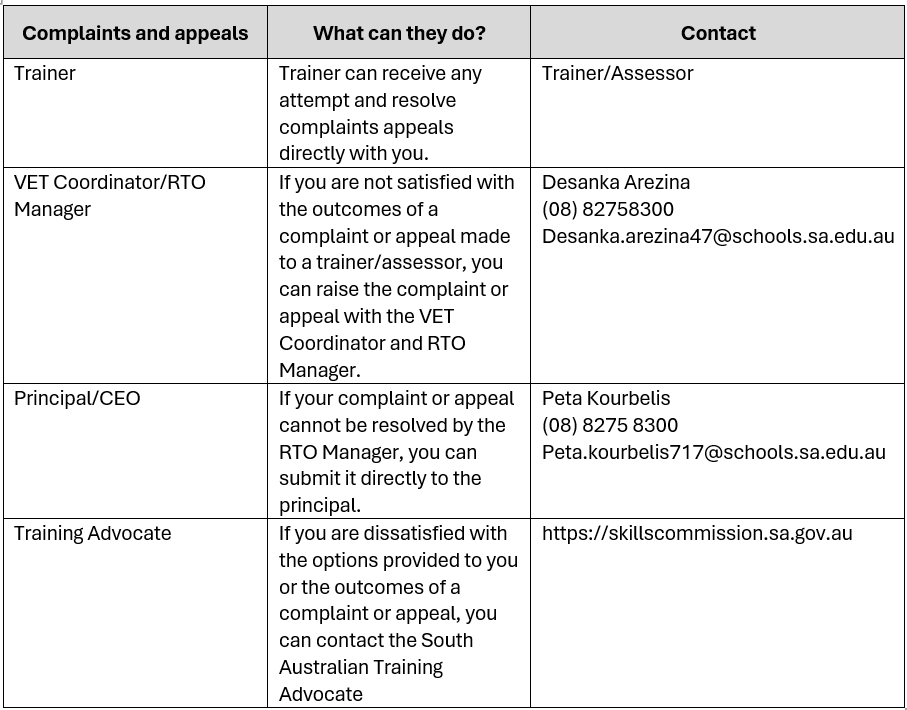
A copy of the Complaints and Appeals Policy is available here.
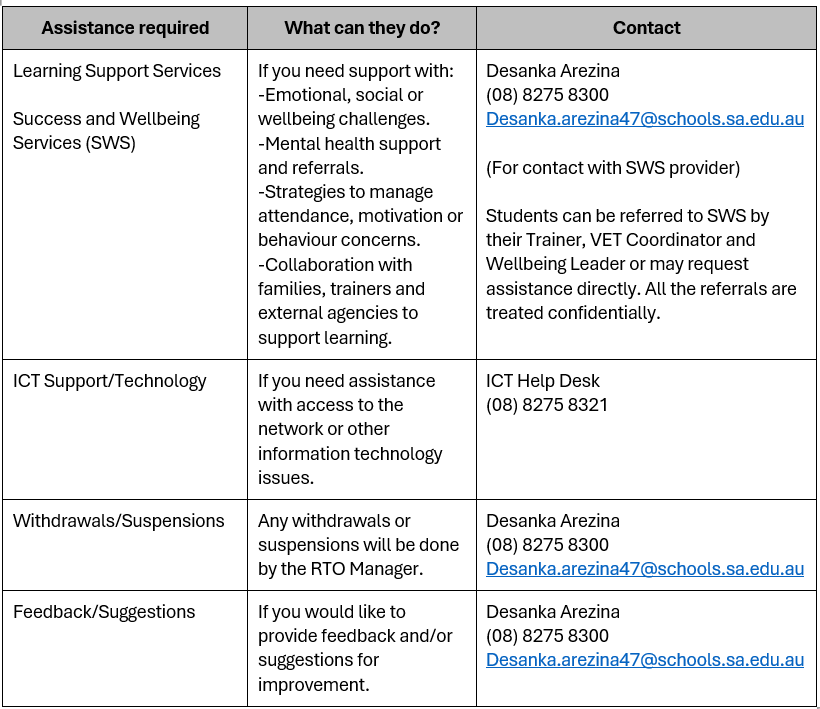
Support Services
Hamilton Secondary College recognises that every student has individual needs and circumstances that may affect their learning.
Learning support aims to:
- Identify and address barriers that impact learning or course completion
- Support students with language, literacy and numeracy needs
- Improve study skills and confidence
- Reconnect to training and support retention
- Assist students to access wellbeing and external support services
- Assists student to complete their qualifications and transition to employment or further study.
VET Trainers/Assessors are a good first point of contact when students are needing some learning support but unaware where to start.
The Trainer/Assessor can:
- Provide learning assistance
- Help identify any barriers to student progress
- Connect students with Success and Wellbeing Services (SWS).
Other sources of useful information include:
Recognition of Prior Learning/Credit Transfer
Recognition of Prior Learning Policy
All VET students shall have access to, and be offered, Recognition of Prior Learning (RPL). At the start of each course, the trainer will be responsible to ensure that students are informed of RPL procedures
When approached by a student seeking RPL, trainers will inform the VET Coordinator who will assist in coordinating the RPL process.
Students will be informed of the requirements of each unit of competency and any supporting evidence they may need to collect to be used in the RPL process. This may include a range of different forms of evidence, such as resumes, job descriptions, portfolios and work samples, documents, letters of validation among others.
The trainer will examine the evidence provided by the student and determine the requirements for RPL assessment. This generally involves interviews, practical demonstrations, contacting referees and other strategies for evidence collection. These assessment decisions will be based on the Rules of Evidence:
- Validity
- Sufficiency
- Authenticity
- Currency.
When making decision in relation to RPL, trainers will take into consideration the evidence produced and the outcomes of the assessment process to determine any existing gaps in leaning and assessment. The student will be informed of the outcomes.
The trainer will retain all evidence and records in relation to the RPL assessment in the student file.
Students who are not satisfied with the outcome of their RPL application may appeal the decision following Hamilton Secondary College’s Complaints and Appeals Policy.
Credit Transfer
If a student has successfully completed nationally recognised units of competency or qualifications from another RTO may apply for Credit Transfer (CT). Hamilton Secondary College will ensure that all applications are processed fairly, transparently and consistently.
1) Applications for Credit Transfer should be submitted to the VET Coordinator at enrolment or as soon as possible. The student must submit official certificates, statements of attainment or transcripts as evidence of completed units.
2) The VET Coordinator will verify the authenticity of the documents. Only units that match those on Hamilton Secondary College’s scope of registration are deemed equivalent and will be approved for Credit Transfer.
3) Students that are granted the Credit Transfer are exempt from completing the corresponding units in the current course. The Credit Transfer will be recorded in the student’s file and the results will be reflected on the student’s academic record.
All Credit Transfer documentation will be stored in accordance with Hamilton Secondary College’s Records Management and Retention Policy.
Students who are not satisfied with the outcome of their Credit Transfer application may appeal the decision following Hamilton Secondary College’s Complaints and Appeals Policy.
Fees and Refunds
Hamilton secondary College is committed to transparent and fair practices in relation to fees and refunds for VET courses.
Payment of Fees
- All course fees will be invoiced and paid by the student’s Home School. In return, the student’s Home School will invoice the student’s parent/guardian.
- A cooling off period of two (2) business days applies to all fees.
- Administration fees are non-refundable after the cooling off-off period is finished.
Refunds
- Students will receive a full refund for tuition fees if withdrawing from a course within fourteen (14) days of course commencement.
- Withdrawals after this 14-day period will not normally be eligible for a refund.
- If special circumstances lead to a withdrawal, the RTO may refund all or some of the fees paid by the student. In these cases, the student will be required to provide detailed and relevant evidence to support their request for a refund.
- Students are entitled to a full refund of fees paid if the course does not commence or is terminated by the RTO. Refunds do not apply if the student is expelled from the course for misconduct, breach pf policy or breach of legislation.
- Refund requests must be submitted in writing to the VET Coordinator, including any supporting evidence (if relevant).
Continuing enrolments exceeding the finish date specified in the enrolment agreement will incur additional payment of the respective yearly administration fees.
Privacy
Hamilton Secondary College is committed to protecting the privacy of personal information of its students and will collect and store information regarding your progress and achievements in accordance with the Privacy Act 1988 (Cth), the Australian Privacy Principles, ASQA RTO Standards 2025, Department for Education SA and Hamilton Secondary College requirements.
Hamilton Secondary College is obliged to report to various government agencies on training activity. Refer to the privacy notice section on the enrolment form for more information. This will include the Australian Vocational Education and Training Management Information Statistical Standards (AVETMISS) for the collection and analysis of Vocational Education and Training information throughout Australia.
Issuance of Qualification and Statement of Attainment
On successful completion of a full qualification, Hamilton Secondary College will issue the student with the relevant Qualification within 30 days of assessment and successful completion.
Where a full qualification is not completed, a Statement of Attainment (SoA) will be issued for the successful completion of any relevant units of competency successfully completed by the student.
Replacement Certificates and Statement of Attainments are available upon request and may incur the payment of an administration fee.
Rights and Responsibilities
Hamilton Secondary College aims to provide a high-quality education and training service in which all students are encouraged to strive for excellence and fulfil their potential
Students and staff have a right to work and study in an environment free from harassment, discrimination or threatening behaviour. This right is accompanied by everyone’s responsibility to respect:
- The rights of others
- Difference and diversity
- People’s rights to privacy and confidentiality.
The right to have your say is balanced with the responsibility to listen to others. You can expect staff to:
- Treat people in a fair, respectful and non-discriminatory way
- Be professional in performing their duties
- Maintain confidentiality and protect personal information in accordance with privacy legislation
- Support learners to participate fully and safely in all Hamilton Secondary College activities.
Students have a responsibility to:
- Observe any class rules or behaviour guidelines set by your trainers
- Behave in a manner that does not interfere with the learning of others
- Use Hamilton Secondary College facilities, equipment and digital platforms responsibly.
Examples of unacceptable behaviour:
- Refusing to follow reasonable instructions from staff or supervisors
- Discrimination and harassment of any kind
- Bullying and intimidation
- Making racist, sexist or offensive comments or behaviour
- Violence, assault or threats towards others
- Behaving in a disruptive manner such as swearing, yelling or using offensive language
- Viewing or distributing offensive material via the Internet, e-mail or other means
- Possession, use or distribution of illegal drugs or alcohol
- Vandalism, theft or causing wilful damage to property
- Endangering the safety or welling of self or others.
Consequences of unacceptable behaviour
Hamilton Secondary College follows fair and transparent procedures in addressing misconduct. Depending on the nature and severity of the behaviour, consequences may include:
- Verbal or written warnings
- Temporary suspension from training
- Removal from specific learning activities or Hamilton Secondary College premises
- Formal review of enrolment status by the RTO Manager
- Expulsion in serious cases, where behaviour threatens safety, wellbeing or Hamilton Secondary College property
- Referral to external authorities, including South Australia Police for criminal conduct.
Harassment, Victimisation and Bullying
Harassment, victimisation and bullying are abuses of power characterised by aggressive behaviour or actions that intimidate, humiliate and/or undermine a person or group.
Hamilton Secondary College is committed to providing a safe, inclusive and respectful learning environment through:
- Taking complaints or reports of harassment, victimisation or bullying seriously and confidentially
- Promptly investigating and addressing reported incidents
- Ensuring that students are not disadvantaged for raising a concern or complaint
- Providing access to Success and Wellbeing Services (SWS) or other support programs.
Students are expected to:
- Treat others with dignity, respect and fairness
- Refrain from engaging in any form of harassment, victimisation or bullying
- Speak up or report concerns to a Trainer/Assessor, VET Coordinator or Wellbeing Leader
- Support a positive and inclusive learning environment.
Confirmed incidents of harassment, victimisation or bullying may result in:
- Mediation (where appropriate)
- Behaviour agreements or formal warnings
- Suspension or removal from training
- Expulsion for serious or repeated misconduct
- Referral to external authorities, including South Australian Police if the behaviour is unlawful.
Changes to course/study
Hamilton Secondary College is committed to keeping students informed about any changes that may affect their training. Students will be notified promptly of any significant changes to course, including:
- Course content or delivery mode
- Training and assessment arrangements
- Class schedules or venues
- Changes to trainers/assessors
- Suspension, transfer or discontinuation of a course.
Students will be notified of any such changes in writing (by email) within 28 days of the change being confirmed.
Hamilton Secondary College will work with the students to minimise disruption and ensure that suitable arrangements are made to support course continuity and successful completion.
Training Provider Closes
Training providers may close for a range of reasons, including:
- They are no longer financially viable
- ASQA has cancelled their registration
- The business owner can no longer deliver training.
Unfortunately, some training providers close while still delivering training. If this occurs you need to:
- Plan to continue your training
- Collect evidence of your training
- Recover or pay any outstanding fees
- Transfer your training to another registered training organisation.
Source: https://www.asqa.gov.au/students/what-do-when-your-training-provider-closes